
How to Use Connective Instruction to Get a 7x Boost in Engagement
A.J. Juliani
There are three distinct categories of teaching practices: Lively Teaching (group work, games, projects, movement, constructing knowledge socially), Academic Rigor (cognitively demanding tasks, high expectations with passionate investment in content), and Connective Instruction (helping students see the curriculum as something that matters to their current lives and their futures).
Of these, Connective Instruction predicted student engagement more than seven times as strong as the others based on a study done by Kristy Cooper at Michigan State University. The three strategies worked well in combination but connective instruction was the driving force.
Connective Instruction includes:
- Promoting Relevance
- Not in a forced way but to bridge the gap between curriculum and experience
- Showing You Care
- Empathy in action
- Showing Concern for Well-Being
- Knowing students’ lives beyond the classroom
- Providing Affirmation
- Telling them they are capable and following up with praise, written feedback, and structured opportunities for success
- Relating Through Humor
- Humor that says, “I enjoy being around you.”
- Enabling Self-Expression
- Connecting learning with identity through expression of ideas, values, and conceptions of self
Our students are desperate for high-quality connections with the adults in their lives.
Although achievement matters, the impact of connection is more important. Build a classroom where students feel like they belong.
Click here for the full article.
Big Picture Thinking: How to Educate the Whole Person for an Interconnected World
By Veronica Boix Mansilla and Andreas Schleicher (associated with Harvard University’s Project Zero)
Skipped to Section 2: What kind of learning do we seek? Making global competence learning visible.
Rather than learning being viewed as “knowledge acquisition or mastery,” it should be thought of as thinking with and applying information in a range of situations, including examining and making sense of ideas, theories, sills, values, and applying them to the world.
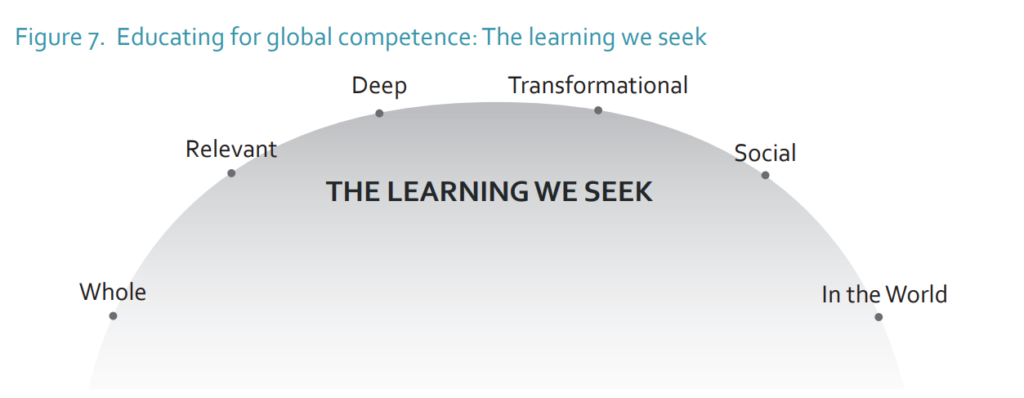
Achievement is not limited to the development of cognitive skills but focused on the kind of persons our young people become, embodying self-understanding, managing emotions, and upholding values.
Boix-Mansilla et al. 2015, Council of Europe 2018
Whole Learning
Philosophers have long challenged the separation of cognition and emotion. Additionally, in recent years, neuroscientists have argued that emotions serve an orienting function in cognitive endeavors through selective attention and memory encoding in the brain.
Examples:
- Communicating with native Afro-Caribbean Spanish speakers = Joy
- Learning about slavery = Anguish and Dehumanisation
- Wisdom in poetry or literary works = Intellectual humility
- Human inequities = Ethical dilemmas
Relevant Learning
Relevant learning starts with knowing students’ backgrounds and can be personal. Relevance can also stem from ideas like identity, culture, and syncretism. It can also be from universal reach (such as the number of people and regions affected by a historical event).
Relevant learning responds to the legitimate query “Why do we need to learn this?” by moving attention away from syllabi and exams and toward the intrinsic significance of proposed topics, questions, or experiences for students’ lives and societies.
Relevance includes making sense of emerging phenomena like a pandemic, understanding the experience of refugee families, climate-change impacts, learning about other cultures, planetary health, healthy relationships, estimating population growth, and the planet’s carrying capacity. These themes are likely to be relevant for decades to come.
Deep Learning
Deep learning for global competence involves the practice of applying knowledge and modes of thinking characteristic of disciplines like history, mathematics, science, the arts, vocations, and crafts in novel situations as students learn to investigate the world, take perspective, communicate across difference or take action.
Examples:
- Instead of Spanish worksheets, students use the language to describe photos of their childhood, interview schoolteachers, or present their research to the class. Spanish is used as a gateway into a new world and to build an understanding of another culture.
- Instead of memorizing information about climate change and rising sea levels, students modeled the impact. This naturally involved more scientific thinking and reasoning. It also showed them in s subtle way the power the have to make tangible differences. *I assume these experiences would also be talked about a home due to the “fun” factor which would raise awareness in a further reaching way.*
Deep learning can naturally include hypothesis testing, field observation, data collection, and research. These skills are important in the current times of misinformation and with the unprecedented volumes of information available at students’ fingertips.
Social Learning
Classroom environments need to have trust, care, and understanding to facilitate this type of learning. This is closely tied to a sense of belonging and connection.
Laughter, challenge, thoughtfulness and bonding characterize the climate in which students develop global competence in relationship with others.
Learning with and about others is important in classrooms.
Transformational Learning
Lesson idea for vocabulary and ethics: Students describe an ethical issue but are not allowed to use a list of words such as wrong, weird, or strange that would diminish the people involved in the cultural practice. *Maybe with a list of words they must use?*
Transformational learning is here understood as learning that is long-lasting — a shift in insight, capacity, and mindset that remains with the students well after a unit of instruction is completed. It becomes part of students’ worldviews, re-orienting their sense of self, the world, and the habitual ways of interacting in it.
The many hours students spend in school should be impactful and help them become global and interculturally competent persons, rather than master and memorize isolated skills.
The goal is to nurture a disposition that involves the ability to examine complex issues, reason with evidence, take perspectives, communicate reflectively, and assess courses of action; sensitivity to real world opportunities and applying these abilities flexibly; and inclination to do so unprompted over time across different contexts. It’s about developing active habits of mind that become part of students’ intellectual character and worldview. This is best developed through cultural immersion.
“In the World” Learning
“In the world” learning can include authentic, experiential, project-based and service-learning. The key is that it involves going out of the school and interacting with the rest of the world, society, and people.
Benefits include:
- intrinsic forms of motivation
- nurturing students’ sense of agency
- preparing them to tackle complex issues and investigate open-ended questions under real-world conditions
- preparing them for the future
- teaching students to distinguish essence from noise
- learning to manage social relationships, exercise agency, mange their self, calibrate values, establish and reflect on standards of quality
Learning to navigate our complex, often unpredictable, and
ambiguous world benefits from real-life experiences in which students engage with real
people, real issues, real relationships, real contexts, and real audiences to explore real and
relevant problems that call for real explanations, solutions or innovations.
Summary
“From this standpoint, equity-driven practices will involve finding ways to get to know students as whole persons in their full – all too often untapped – potential; to ensure ample opportunities to engage in deep, social, and transformative learning; and to capitalize on and extend their informal expertise (cultural, linguistic) to tackle real issues affecting their lives and lives around the planet.”
Click here for the full article.
Professional Development Day
Leave a Reply
You must be logged in to post a comment.