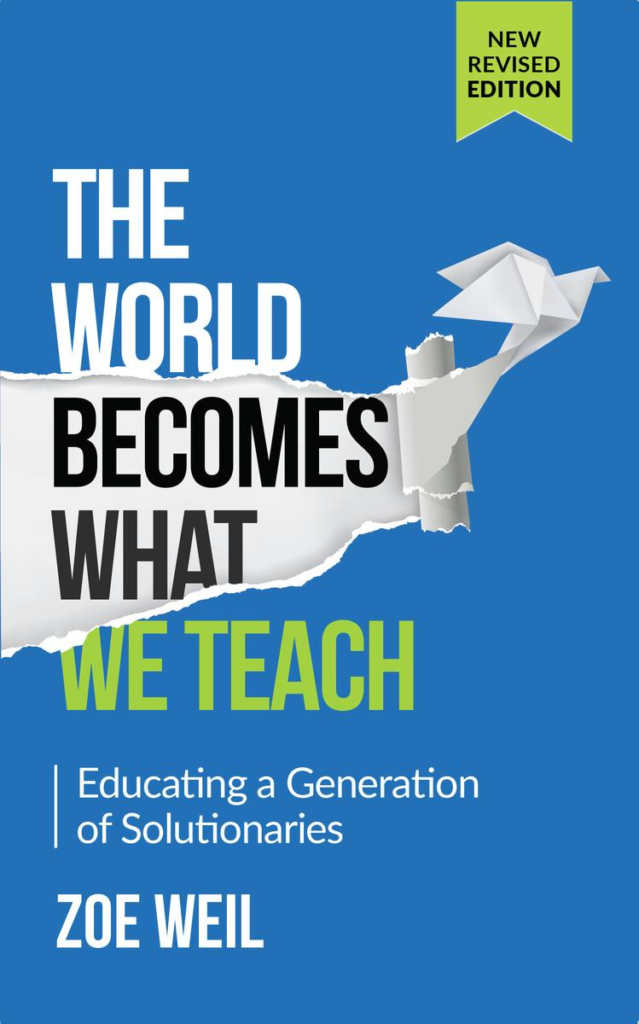
Throughout CONT 919, The World Becomes What We Teach: Educating a Generation of Solutionaries by Zoe Weil was read. The themes and strategies that resonated with me the most are described below. These themes and strategies align with the BC Curriculum and Education for Sustainable Development.
Systems Thinking
The main components of Solutionary Thinking, as described by Weil, include critical thinking, strategic thinking, creative thinking, and systems thinking. The systems of our society, including “energy, production, transportation, agriculture, political, and economic systems[,] perpetuate many of the challenges and crises before us” (Weil, p. 22). Understanding how these systems work and the potential for chain reactions throughout a system is important to know as we work to solve systems that contribute to climate change. As Weil states, “attempting to solve a problem in isolation may potentially exacerbate other problems inextricably linked through various systems” (Weil, p. 22).
With Weil’s solutionary focus being on system changes instead of problem-based solutions, it makes sense that Weil would emphasize the importance of healthy food in schools. With food waste being a major contributor to climate change and based on her connection of fast food causing early deaths in people and the dead zone in the Gulf of Mexico, food is very connected to a sustainable world. If school is the place to learn, it makes sense that it should be a place to learn and practice healthy and sustainable eating practices, especially since food is something we think about daily. As she states, “we not only help children stay healthy and develop lifelong healthful eating habits, but also model just, humane, and sustainable food choices.” It a good example of practicing what we preach. If students are learning about healthy eating, the school food programs should serve as an example.
A Just, Healthy, and Peaceful World is Possible
As stated by Weil in the section titled “Let’s teach children that a just, healthy, and peaceful world is possible,” why would anyone bother to work towards solving climate change and it’s system of causes if they don’t believe it’s a problem that can be solved? Feelings of hopelessness would lead to students being disengaged with learning and projects. It would also lead to feelings of despair. Like the section title, we need to “teach children that a just, healthy, and peaceful world is possible,” (Weil) whether it’s through visualization or looking at small-scale examples of system changes that could be scaled up. Students need to see the possibility of a sustainable future. Additionally, focusing on hope as an action-driven belief can work to combat feelings of hopelessness and eco-grief.
Interdisciplinary Learning about Real-World Issues
To make my teaching more interdisciplinary and organized around real-world issues, I can take suggestions from Weil such as using a current issue as an overarching topic to tie learning of multiple subjects to. Luckily, I teach a grade 7 core class. With teaching the same students for all their subjects other than exploratory, I can pick an issue or theme to cover over a period of time. I like Weil’s suggestion of looking at climate change statistics and graphs in Math and reading climate change related literature for English while learning about climate change in Science. We could also explore climate justice and global citizenship for Careers and discuss the global inequalities that are exacerbated by climate change. The Socials 7 curriculum is focused on ancient civilizations. To tie that topic to climate change, students could compare the fall of civilizations to problems our modern civilization is facing.
Another climate change related topic that can have interdisciplinary applications in salmon. The life cycle of salmon, the way climate change is affecting that cycle, and how the effects on the traditions of local Indigenous peoples is a complex system that can apply to multiple subjects including science,
Breadth (and Thinking Skills) Over Depth
Students don’t need to memorize random information that they can find online, as long as they have exposure to a wide range of topics and ideas so they know they exist. Weil states that “students should learn a little about many subjects.” Instead of details about fewer subjects, they need to know how to think critically about ideas they’re presented with and differentiate between fact and fiction while applying problem-solving skills. The solutionary lens focuses on these skills, and breadth, over depth of content, which some schools or educators may currently be focused on. “Knowing how to carefully research, evaluate, and interrelate various disciplines matters more than choosing limited, specific subjects for study” (Weil, p. 18).
Individualized Curriculums
Individualized curriculums allow students to pursue their passions and at their own pace. There are many different solutions required to solve climate change. Teaching based on a single or a select few ideas on how it can be solved wouldn’t necessarily result in passion from students. On the other hand, if they can pick a subtopic related to what they’re already passionate about while learning about the climate change, students will be more engaged in their learning and it will be more meaningful to that individual. As Weil states, “solutionaries come with different passions and talents,” so those passions and talents should be used for learning the skills they need for future careers “while bringing a solutionary mindset that not only increases their value to an employer or college but also contributes to healthier and more just and sustainable societal systems” (Weil, p. 43).
Varied Pedagogical Approaches
There are aspects of each pedagogical approach suggested by Weil that would be amazing to have students engage in, but many feel unrealistic based on the capabilities of my class last year. Her suggestions include inquiry, independent research, experiential learning, mentoring, collaborative work, case studies, having guest speakers, and using films and other multimedia sources (Weil, p. 38). With many students needing lots of help reading and writing and, even with a full-time educational assistant, I often felt stretched thin when it came to helping students get through more cognitively demanding assignments, even with scaffolding and background knowledge previously covered. With that in mind, the approaches that resonated with me the most, and would pair well with foundational skill building, are using films and other multimedia sources and discussing them, using re-life case studies, having students work collaboratively, and having guest speakers present about topics related to climate change. These options would work well together to expose students to multiple perspectives and ways of obtaining knowledge. Additionally, collaborative work helps students build valuable real-world skills.
References
Weil, Zoe. The World Becomes What We Teach: Educating a Generation of Solutionaries. New York Lantern Books, 2016.
Published: