With Experiential Learning and C.A.R.E. Principles
The list below contains components of the environmental stewardship action plan that will be completed. The separate sections on the navigation menu directly above provide supporting strategies for how intersectionalities, culture, pedagogical approaches, solutionary thinking, and student well-being will be considered and supported throughout this stewardship plan.
To reduce the amount of carbon emissions, adjustments should be made to the school food program. Many students rely on the school for their breakfast and lunch. Although this food is critical, there are still large amounts that end up in the garbage. As food decomposes in a landfill, due to the lack of oxygen, methane gas is released into the air, which is a lot worse than cardon dioxide (Team Compost Connect). Additionally, the transportation of food waste produces more carbon emissions. There are three ways we will reduce these emissions.
Reduce Food Waste
The first is to encourage students to not waste food. If students took only what they knew they would eat, there would be less waste. Students in Ontario successfully reduced their school’s food waste by half in 2025 by informing other students. Check out the CBC Kids News article here for inspiration.
Composting
The second way to prevent food from ending up in the landfill is by either starting a school composting program or sending food waste to the municipal compost program. Although composting still releases carbon dioxide, it’s a gas that’s less potent than methane and the finished compost is “a valuable soil enhancer that helps plants thrive” (Gibbens). This soil is also better for the Earth than commercial fertilizers. “Better soil helps support plant growth, which can help sequester carbon from the atmosphere. Stronger, nutrient-rich soil also reduces the need for fertilizer and pesticides, which are pollutants themselves and are often produced with destructive mining practices and a high carbon footprint” (Gibbens).
Less Meat and Dairy
Finally, serving less meat and dairy can help reduce carbon emissions. This is because of the processes involved with raising livestock including “deforestation and clearing of land for agriculture and grazing, digestion by cows and sheep, the production and use of fertilizers and manure for growing crops, and the use of fossil fuels to run farm equipment or fishing boats” (United Nations). Due to these supply chain considerations, “the meat and dairy industry is responsible for around 14.5% of global greenhouse gas emissions, as well as a major driver of biodiversity loss, so it’s an important sector to focus on” (Friends of the Earth, p. 8). Although the supply chain of fruits and vegetables also results in carbon emissions, the results are less when the the food isn’t being fed to animals first.
Organize the school garden
There is a lot of potential for the school garden. Even though school is not in session in the summer, crops with short maturity lengths could be grown and used for the school breakfast and lunch programs. This could include radishes, lettuce, spinach, herbs, and berries that mature in the spring, such as early strawberries. By organizing who does what and what is planted where, students and staff could be more involved and reap the benefits together. Organizing could start as simple as a schedule and a map after finding out which classes wish to be involved. As stated in the Sustainable Schools Best Practices Guide, “involving students in ongoing school garden projects allows them to learn about the cycles of life and engage in fun outdoor learning” (BC Ministry of Education). The food harvested in the garden could be used for the food program.
Student Involvement
These changes will be made with student input and cooperation through surveys, students completing research to determine best course of action, and students informing other students of food-based carbon emissions. Students will also be involved in planting and caring for the school garden.
The mitigation of food waste will involve an initial audit. Within the first month of school, we will collect all the garbage cans after lunch and take note of how much food and lunch-related garbage is in them. This will allow students to directly experience how much food is going to the landfill. We’ll reflect on how much this would add up to over the course of the year. Then students will collaborate and figure out how to reduce the amount of waste going to the landfill. They’ll learn about the complexity of composting and the maintenance a compost pile requires. We’ll also visit the landfill to see it’s affects on nature. It’ll be their responsibility to implement changes to reduce carbon emissions.
Community Assets
Community assets that will be pursued for information and resources include the Community Garden and Day Break Farms egg farm. We can learn how to grow vegetables in the school garden to make sustainable contributes to the food program. From Day Break Farms, we can learn more about the supply chain for eggs. This information will also increase student awareness and gratitude for food products, especially animal products.
As a class and while encouraging other classes to participate, our class will see how much we can reduce our carbon footprint of getting to school. Before and after school, the parking lot and side streets around the school are filled with vehicles picking up and dropping off students. Many students take a school bus and some already walk or bike, but a large portion of the students being dropped off either qualify to take a school bus or live within walking distance of the school. Additionally, students that live further away usually have a friend near by and might be able to carpool. Emphasis will be placed on the positive effects of taking the bus because the number of students that take the bus to school in BC each day removes “60,000 vehicles that would otherwise be on the road” (BC Ministry of Education).
Although not all students can walk, bike, or carpool, the flexibility of the goal is designed to, ideally, include all students in collectively getting to school in a more sustainable way.
Additional Strategies to Reduce Carbon Emissions
Designate the parking lot as an idle-free zone.
By putting idle-free zone signs in the parking lot and encouraging parents to turn off their engines when they wait, less carbon emissions will be released when students are being dropped off and picked up. According to the Sustainable Schools Best Practices Guide, “idling a vehicle longer than 10 seconds uses more fuel and produces more emissions compared to restarting the engine” (BC Ministry of Education, p. 28). With this in mind, a very large about of carbon emissions can be reduced simply by turning off engines while waiting. To spread the word, the school could “put up posters outside the school, leaflets at pick-up and drop-off with the help of nominated eco-champions and ask students to take leaflets home” (Friends of the Earth, p. 4). The long-term benefits of an idle free zone could be immense.
Encourage teachers to take the city bus on field trips.
Not only is the bus already going along it’s route, but it’s also free for kids 12 and under in Terrace. That means before January, all grade 7 students can ride the bus for free. Once students turn 13, it’s only $1.75 to ride it and it’s $2 for adults. There’s a bus stop in front of the school grounds and another route stops along the side. Between these two routes, there are many different places the bus can be taken for a field trip for a “greener school trip” (Friends of the Earth, p. 5). Additionally, taking public transit as a class will give students the knowledge and confidence for them to do it on their own. If used to their maximum potential, “one city bus can take 40 vehicles off the road and save 70,000 L of fuel” (BC Ministry of Education, p. 27).
The schedule for the city bus can be found here: BC Transit Schedules and Maps
Organize a campaign for a GoByBike Week.
Encouraging students and staff to ride their bikes or walk to school to reduce the collective carbon emissions has the potential to be very impactful. As an example, seen in the Sustainable Schools Best Practices Guide, a school set a goal to get “90% of students walking to school on Wednesdays” and the result was “increased participation from 65% to almost 90% over a five-month period” (BC Ministry of Education, p. 4). Since “transportation contributes a full 45% of total household greenhouse gas emissions in BC” (BC Ministry of Education, p. 27), a successful GoByBike week, or similar campaign, can make a big impact on climate change. As stated on their website, the 2025 GoByBike weeks participation had an impact similar to “removing the annual emissions of about 600 typical passenger cars from the road for one year” (“GoByBike BC – Bike It. You’ll Love It.”).
Encourage eligible students to ride the bus
Emphasis will be placed on the positive effects of taking the school bus because the number of students that take the bus to school in BC each day removes “60,000 vehicles that would otherwise be on the road” (BC Ministry of Education). Including the positive effects of riding the bus increases the flexibility of this goal and, ideally, includes all students in collectively getting to school in a more sustainable way.
As our class explores waste and energy throughout the school year, students will look for ways our school could be made more sustainable and advocate for those changes. This will help students think critically about energy and resource consumption while building skills in persuasive letter writing, supporting arguments, and respectful communication. Although all changes might not happen, if even a small change is successful, it will help them see their power to make change and take responsibility for their actions, even while being in grade 7. Sustainable operations changes could include suggestions from the Sustainable Schools Best Practice Guide, such as switching to compact LED bulbs, hand driers instead of paper towel dispensers, and pushing for more sustainability within the breakfast and lunch programs. Not only will this goal help students in the class make positive changes in their own school, but it aligns with “solutionary thinking”, as described by Zoe Weil, and develops critical thinking skills.
Terrace is located on the traditional territories of the Ts’msyen Peoples along the Skeena River. The river is widely known for the sockeye salmon that rely on it. However, climate change has been affecting the salmon population. Exploring this topic will bring relevance to learning as it is a local issue that relates to the global problem of the ocean warming. While exploring this topic, we can learn from SkeenaWild and the Kitsumkalum Fish and Wildlife Department.
SkeenaWild Workshops
SkeenaWild is a local conservation trust that “is committed to securing a future where the Skeena Watershed and nearby communities are a global example of balance and sustainability” (SkeenaWild). They also offer free classroom and land-based workshops. Workshops that tie to this topic include:
- Workshop 1: The Life & Times of Skeena Salmon
- Workshop 2: Healthy Watershed, Healthy Salmon
- Workshop 3: Climate Change & Skeena Salmon
- Workshop 4: Stream Explorations (Outdoor Field Experience at Local Water Body – May and June)
SkeenaWild also offers lesson plans for educators to use in the classroom on their here on their website.
Kitsumkalum Fish and Wildlife Department
Kitsumkalum is part of the Ts’msyen First Nation. Their fish and wildlife department has been conducting climate change research. As stated on their website:
“To better predict and assess the impacts of climate change, we continually study, track and compare trends in the landscape and productivity of the Kitsumkalum watershed. We do so by referencing historical databases and conducting research in hydrology, biodiversity, fish studies, meteorology, glacier studies, water quality, and stream and lake productivity.” (Kitsumkalum)
Their comprehensive research covers the complex system of climate change and the affects it has on salmon. Their valuable knowledge aligns with the solutionary thinking goal of this stewardship plan. To learn from them, whether it’s by hosting a guest speaker or land-based learning with them, would bring invaluable local relevance and cultural connections to students’ learning.
Kitsumkalum Band – Fish and Wildlife Department
BC Curriculum Connections
This interdisciplinary topic relates to Science 7 (organisms have evolved over time; survival needs, natural selection; First Peoples knowledge of changes in biodiversity over time; evidence of climate change over geological time and the recent impacts of humans), Socials 7 (origins, core beliefs, narratives, practices, and influences of religions, including at least one indigenous to the Americas), and Careers 7 (local and global needs and opportunities; cultural and social awareness; factors affecting types of jobs in the community). Lessons can also be developed that relate to Math 7 and English 7 with ease.
The below lesson plan about biodiversity loss, which is a tied to the ocean warming, uses the Environmental Learning and Experience (ELE) Learning Cycle and C.A.R.E. elements.
The Learning Cycle is the “how” of experiential learning and incorporates:
- direct experience
- critical reflection
- conceptualization
- negotiation
The C.A.R.E. elements, as seen in the below image, incorporate:
- Complexity: the complexity of systems, natural and human-made, and how people interact and affect those systems
- Aesthetics: an appreciation for the beauty of nature that leads students to learn more and protect the environment
- Responsibility: both having students take responsibility through action and considering the consequences of their actions
- Ethics: practicing environmental ethics based on values that can give rise to new visions, possibilities, and actions
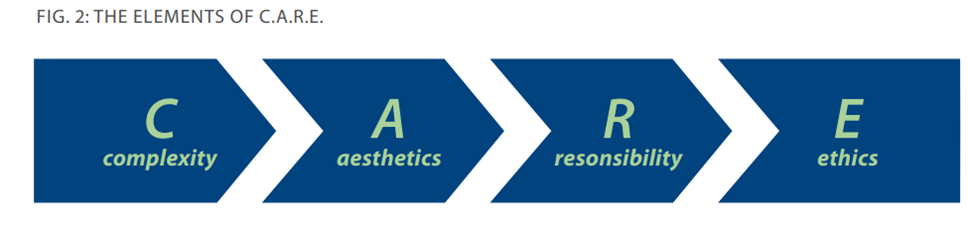
The above information can be found in The Environmental Learning & Experience Curriculum Maps published by the BC Ministry of Education.
Although the biodiversity loss explored in the lesson plan is focused on land organisms, the complex system of climate change connects this topic to the warming ocean as biodiversity loss is also experienced in the ocean and the increased temperatures are being experienced in water and on land due to carbon emissions. Additionally, this relates to the salmon lifecycle because Howe Creek Trail has a salmon hatchery and is a habitat that contributes to healthy salmon.
References
BC Ministry of Education. Sustainable Schools Best Practice Guide. https://www2.gov.bc.ca/assets/gov/education/kindergarten-to-grade-12/teach/teaching-tools/environmental-learning/sustbestpractices.pdf.
“Curriculum | Building Student Success – B.C. Curriculum.” Government of British Columbia, n.d., curriculum.gov.bc.ca/curriculum.
Environmental Educators’ Provincial Specialist Association (EEPSA) and BC Hydro. The Environmental Learning & Experience Curriculum Maps. BC Ministry of Education, 2008/2009. https://www2.gov.bc.ca/assets/gov/education/kindergarten-to-grade
12/teach/teaching-tools/environmental-learning/ele_maps.pdf.
Friends of the Earth. Climate Action Plan for Schools and Colleges. 2021, https://groups.friendsoftheearth.uk/sites/default/files/documents/2021-07/SCHOOLS_CAP_JULY_2021.pdf.
Gibbens, Sarah. “How to compost—and why it’s good for the environment.” National Geographic, 16 Sept. 2023,
https://www.nationalgeographic.com/environment/article/how-to-compost.
“GoByBike BC – Bike It. You’ll Love It.” GoByBikeBC, https://gobybikebc.ca/. Accessed 18 July 2026.
Kitsumkalum Band. “Fish & Wildlife.” n.d., https://kitsumkalum.com/departments/fish-wildlife/.
SkeenaWild. “Our Story.” n.d., https://skeenawild.org/our-story/.
Team Compost Connect. “What Happens to Food Waste in Landfills?” Compost Connect, 22 Jan. 2026, www.compostconnect.org/composting-methods/.
United Nations. “Causes and Effects of Climate Change.” United Nation, n.d., https://www.un.org/en/climatechange/science/causes-effects-climate-change.
Weil, Zoe. The World Becomes What We Teach: Educating a Generation of Solutionaries. New York Lantern Books, 2016.
Published: