Ecological Grief and Climate Anxiety
As we face what is happening to the environment, including irreversible loss of biodiversity, it’s normal to feel emotions such as grief, anxiety, and sadness. It’s important to acknowledge these emotions as they come up. This is especially true in the classroom. Ensuring student well-being is being taken care of is critical for maintaining hope.
Ecological grief can come in different forms. It can be acute grief from experiencing climate disasters, grief from slow-onset changes, vicarious grief from seeing others suffering, or anticipatory grief from fearing what will come (Cunsolo). When climate change affects lifestyle aspects, it can also become a forced identity change. This is happening to Indigenous peoples that can no longer practice traditions due to climate change. As stated by an Inuit leader: “Inuit are people of the sea ice. If there’s no more sea ice, how do you be people of the sea ice? (Cunsolo)” Understanding that different people have different experiences with climate change is important for navigating and supporting emotional well-being.
Supporting Mental Health
Ways to support mental health in the classroom include classroom activities focused on emotions such as mourning rituals, movement-based activities that allow students to respond with movement, reflective writing/journaling, and sculpting emotions with the focus being on the process. (Atkinson, p. 42-46) Connecting students with other students through climate action also benefits mental health.
Community Building
Sheltering youth from this problem is not a solution. The United Nations confirms that it falls within the Rights of the Child “to know about, and be involved in, issues that will affect their future” (Sanson, p. 206). Not only is involvement in climate change a right of children, it can help those affected by climate anxiety. Helping young people to connect with each other and take action for climate change “may be the most beneficial approach” (Sanson, p. 207) for climate related mental health issues. Working towards a healthy planet is healthy for people!
As stated by Pierre-Louis, cooperation has “allowed humans to survive even the harshest environmental conditions and to fend off predators that could take us out individually” (Pierre-Louis, p. 140). Cooperation and community is how we will survive climate change. Similarly, Zinn explains that powerful populations have resulted in revolutionary change throughout history and “small acts, when multiplied by millions of people, can transform the world” (Zinn).
To address this need, an environment club for students needs to be created. This could be an independent school club with a teacher sponsor, or it could be associated with a global club such as Roots and Shoots. This program was launched by the Jane Goodall Institute in 1992. By joining Roots and Shoots, the school club would be connected with a global youth community that have a shared goal. The program also provides resources and inspiration for projects.
Click here to check out Roots and Shoots Canada.
Click here for free online courses for educators on the global Roots and Shoots website
Finding Joy
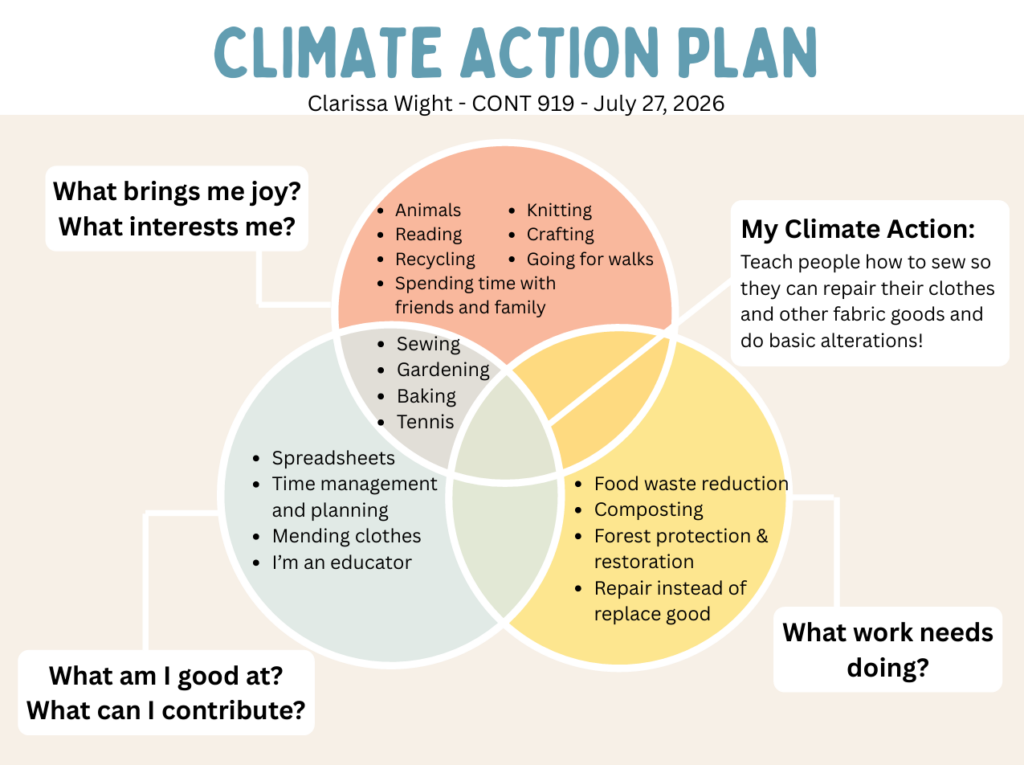
Another strategy is to find joy in climate action. Everybody is unique with different skills that can be used for climate action. As explained by Ayana Elizabeth Johnson in the below Ted Talk, your climate action should relate to what you’re good at, what brings you joy, and the work that needs doing (TED).
The below Venn diagram was completed by me but this activity can be done in the classroom with students. With so many interrelated problems contributing to climate change, we need to diversify our efforts. Therefore, we should focus on what brings us joy as our action. This will also prevent burn out.
Climate Grief and Art
Another way to support students mental health is through art. Art provides a way to express emotions that conversations can’t always achieve. Whether it’s drawing, painting, sculpting, music, poetry, dance, or story writing, art provides a different modality for expression emotions and communicating feelings. The below example is a short story I wrote to express bewilderment and anger at how out society reached the point we are at with climate change.
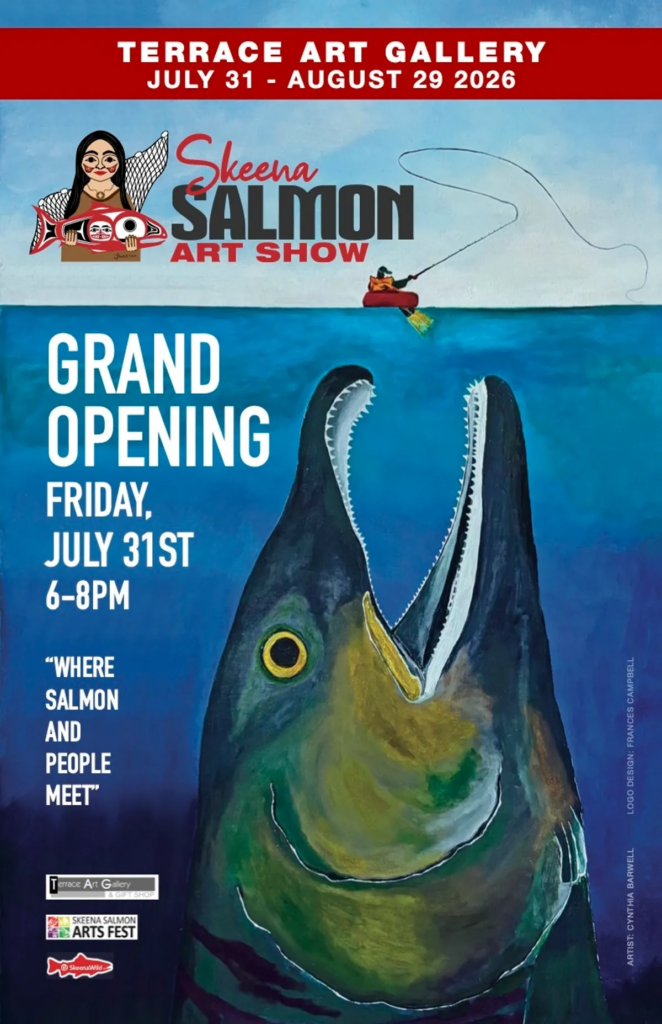
Art is a big part of our community and many of the stunning public displays are focused on salmon or Indigenous artwork. Every August, Skeena Salmon Arts Fest happens and the art gallery has an exhibit with art work from many artists focused on salmon. Often, there art pieces that related to climate change. Although these are summer exhibits, it would be nice to be able to show students pictures of the artwork or have artists visit and discuss their pieces. Additionally, we can do a mural walk through downtown.
Visualizing
Stories are powerful. As humans, we can retain information better if we learn it through a story. Fictional stories often have a way of becoming real. Inventions such as submarines, atomic bombs, and cellphones were based on fictional stories (Pierre-Louis, p. 140). So instead of hearing stories about Earth dying and humans becoming extinct, we need to focus our attention on stories of sustainability.
The pop culture of North America promotes and glamorizes many unsustainable lifestyle aspects. Although I’ve recognized this in social media and it’s focus on overconsumption, I hadn’t considered movies, music, and books as contributors of the same problems. As explained by Favianna Rodriguez, the culture we’ve allowed to become so mainstream openly “condones the exploitation of other human beings and the lands on which they live and severely impacts communities” (Rodriguez, p. 125). Billions of people consume this type of content daily and consider it normal. This is making it difficult for people to imagine or want anything different. This would be especially true for kids that are very impressionable and don’t know to look at things critically. I’m sure there are more kids that say they want to be rich and famous when they grow up than be the ones to solve global warming and live sustainably, because that’s what they most often see and read about.
I haven’t watched Black Panther, but after reading Kendra Pierre-Louis’s explanation of how it shows what a sustainable city could be like (Pierre-Louis, p. 141), I am planning to watch it. I live in a relatively small city (about 15,000 people) so there isn’t something we refer to as a suburb, although some neighbourhoods are further from downtown. I know places like Vancouver are a completely different story though. I remember growing up and the news showing the traffic jams from a helicopter. In addition to the increased carbon emissions, suburbs increase the number of roads going through fragile ecosystems, harming plants and animals (Pierre-Louis, p. 143). Reducing the number of suburbs will not be easy though. Like Pierre-Louis explains, “suburbs emerged in part because cities were polluted, with bad air quality and substandard housing” (Pierre-Louis, p. 142) and these issues would need to be addressed before people would choose to leave the suburbs. Regardless, stories like Black Panther make sustainable living feel more possible. We need more types of stories like this that help us see a future that promotes the health of the environment.
In alignment with this topic, students can rewrite popular stories, either movies, TV shows, or books they enjoy, to be sustainable. Using Black Panther as inspiration, other superhero stories could take place in sustainable societies or a story could promote electric vehicles or public transport as being cool. At the very least, it would help students realize that what they see on TV and in movies isn’t necessarily the dream they should be chasing and that sustainable life on Earth is possible.
Focus on the Positive
Continuing with the visioning, knowing that positive changes are happening and that they just need to happen faster is critical information for maintaining well-being. As stated by Christiana Figueres in the below podcast, there are many tipping points we can’t go back from. Extinct animals will remain extinct. What we need to focus on is what we still have and what we can protect for the next generations. Ensuring that students know about the good, instead of only hearing about the bad, will help them visualize a future where people, animals, and the environment prosper together.
The vision of our future presented by Figueres is so hopeful and yet sounds very obtainable. With the focus on community, collaboration, and mindset, it sounds wonderful to be apart of. Although there are parts of climate change that are too far gone to undo, which her vision recognizes, it’s still a much more hopeful vision for the future than stories like Wall-E. To achieve this vision, we must be thoughtful and intentional about our actions. I enjoyed hearing Figueres example of shopping for produce. You can walk into a store and grab the tomatoes, onions, and avocados you want to buy and leave. Or you can have “a completely different experience about the tomato” (Tippett, Krista) by recognizing the love and collaboration of the growers that resulted in the produce and the store that is selling it. Considering where the things we get come from brings more meaning and gratitude to our actions around those items. With the global impacts of many items available for purchase, there are many impacts that can be considered. Slowing down and thinking about the contributions to an item, whether it’s food, clothing, a vehicle, furniture, or electronics, and the chain of events after we “throw away” an item, changes our mindset and actions. With this mindset, our actions will shift to more sustainable ones and help us achieve Figueres vision.
References
Atkinson, Jennifer. “Eco-Grief and Climate Anxiety in the Classroom.” Contemplative practices and anti-oppressive pedagogies for higher education : bridging the disciplines, edited by Greta Gaard and Bengü Ergüner-Tekinalp, 1st ed., Routledge, 2022, pp. 35–51, https://doi.org/10.4324/9781003201854-5.
Cunsolo, Ashlee and Kiemia Rezagian. “Ecological grief: The mental toll of the climate emergency.” Canadian Climate Institute, 7 Oct. 2021, https://climateinstitute.ca/ecological-grief/.
Jane Goodall Institute. “Roots and Shoots.” https://janegoodall.ca/what-we-do/canada-programs/roots-and-shoots/
Pierre-Louis, Kendra. “Wakanda Doesn’t Have Suburbs.” In All We Can Save edited by Ayana Elizabeth Johnson and Katharine Wilkinson (p. 138-144). One World, United States, 2020, https://onq.queensu.ca/content/enforced/1168454-CONT919SUM26001S26/CONT919/M6.3%20Wakanda%20Doesn%e2%80%99t%20Have%20Suburbs.pdf.
Sanson, Ann and Marco Bellemo. “Children and youth in the climate crisis.” In BJPsych Bulletin 45, Aug. 2021, 205–209, https://pmc.ncbi.nlm.nih.gov/articles/PMC8499628/.
Zinn, Howard. “The Optimism of Uncertainty.” The Nation, 2 Sept. 2004, https://www.thenation.com/article/politics/optimism-uncertainty/.
Published: