
Climate change is the shift in weather patterns and climate that the global community has been experiencing since the industrial revolution. It’s the result of greenhouse gases entering the atmosphere in the form of carbon dioxide and methane gas, “primarily due to the burning of fossil fuels like coal, oil and gas” (“What Is Climate Change?”). As greenhouse gases are released into the air, the ocean absorbs carbon, which in turn heats it up. As stated by the United Nations, “the ocean absorbs around 23 per cent of annual CO2 emissions generated by human activity and helps mitigate the impacts of climate change. The ocean has also absorbed more than 90% of the excess heat in the climate system” (“Life Below Water”).
However, warmer water is detrimental for organisms in the ocean. The effects of the ocean temperature rising include but is not limited to:
- Marine heatwaves
- Threats to the survival of marine life
- Bleaching and killing of coral reefs
- Loss of marine biodiversity
- Rising sea levels
- Increased ocean acidity
- Economic losses for fishing industries
- Melting sea ice
- More extreme weather globally
- And more!
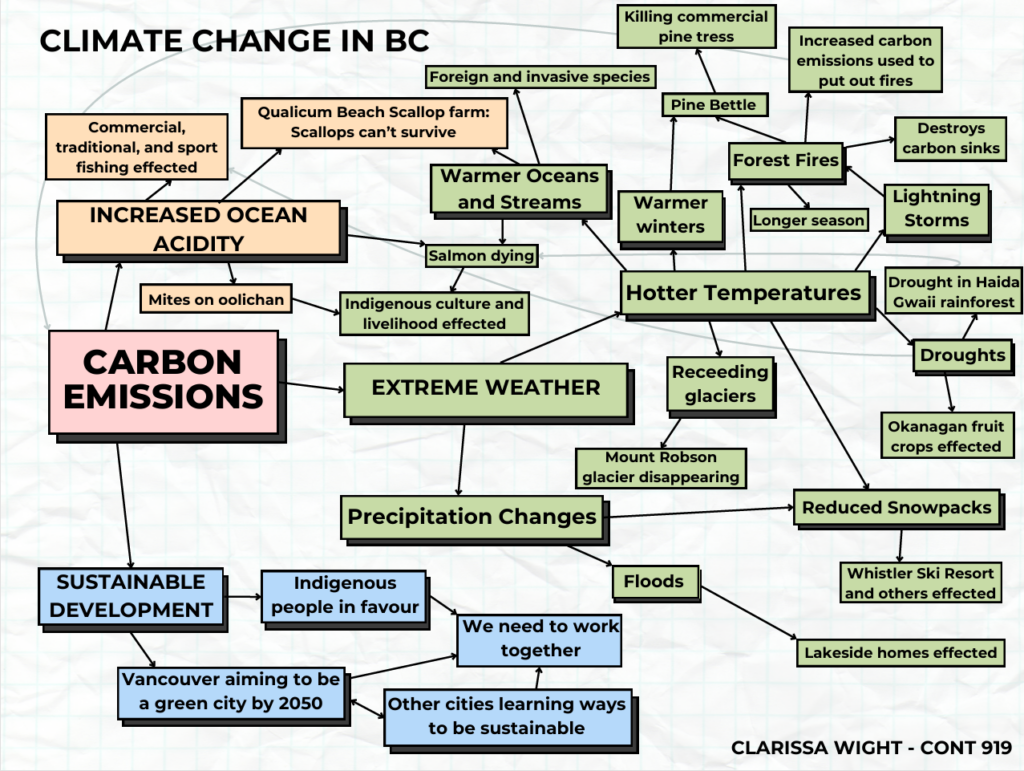
As seen in the mind map below, the ocean warming is part of an interconnected web of climate change effects that are all linked to carbon emissions and the effects are being felt right here in British Columbia. Although other parts of the world may be experiencing more severe affects from climate change, we are not exempt from it. In fact, out of control wildfires are currently burning in much of our province, resulting in evacuations and homes being lost.
United Nation’s Sustainable Development Goals
The United Nation’s is a non-governmental international organization that is made up of 193 member states. The United Nations is the organization that created the Universal Declaration of Human Rights. The UN also created the Sustainable Development Goals, a set of 17 goals that promote prosperity and protection of the planet.
SDG #14: Life Below Water
The warming ocean directly connects to the United Nation’s Sustainable Development Goal #14: Life Below Water. This goal is focused on the sustainable use of the ocean, seas, and marine resources.
The ocean is a critical and substantial part of Earth. It covers 3/4 of Earth, has 97% of all the water, and accounts for 99% “of the living space on the planet by volume” (“Life Below Water”). Between the increase in temperature, acidity, and marine pollution, a lot of it being plastics, the ocean is in dire need of our help. “A healthy ocean and seas are essential to human existence and life on Earth” (“Life Below Water”).
SDG #12: Responsible Consumption and Production
In developed countries, economies are based on consumerism and many people consume substantially more than they need. This is even true for food. According to the United Nations, “a staggering 931 million tons of food is wasted a year, despite a huge number of the global population going hungry” (“Sustainable Consumption and Production”).
Over consuming and wasting food directly relates to the United Nation’s Sustainable Development Goal #12: Ensure sustainable consumption and production patterns. Food waste adds to the carbon emissions in our atmosphere, especially when sent to the landfill. As food decomposes in a landfill, methane gas is released into the air, which is worse than cardon dioxide.
The below video, “The Story of Stuff,” shows how the things we buy add to climate change through it’s creation, use, and after people “throw it away.”
SDG #7: Affordable and Clean Energy
Since the ocean is absorbing so much of the carbon we release into the atmosphere, it is critical that we majorly reduce or eliminate carbon emissions. Fossil fuels have been providing sources of electricity for decades, “but burning carbon fuels produces large amounts of greenhouse gases which cause climate change and have harmful impacts on people’s well-being and the environment” (“Affordable and Clean Energy”).
Additionally, “global electricity use is rising rapidly” and “without a stable electricity supply, countries will not be able to power their economies” (“Affordable and Clean Energy”). Clean energy options, such as solar, wind, and thermal, are expanding, just not fast enough. Switching from fossil fuel sources to clean energy options will significantly reduce the amount of carbon emissions entering our atmosphere globally and reduce the amount of carbon the ocean absorbs.
SDG #4: Quality Education
Quality Education also connects to the warming ocean because education is what will advance all the other goals. As stated by the United Nations, “education is the key that will allow many other Sustainable Development Goals (SDGs) to be achieved.” (“Quality Education”).
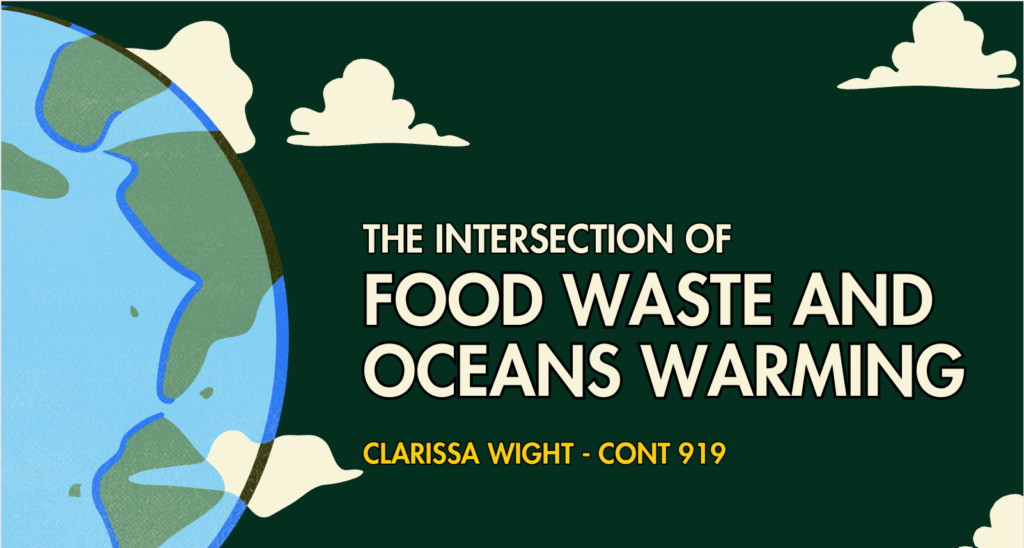
Presentation About Food Waste and Ocean Warming
The below presentation can be presented to a class to teach about the connection between the ocean warming, responsible consumption and production, and life below water.
References
“Affordable and Clean Energy.” Sustainable Development Goals, United Nations, n.d., https://www.un.org/sustainabledevelopment/energy/.
“Life Below Water.” Sustainable Development Goals, United Nations, n.d., https://www.un.org/sustainabledevelopment/oceans/.
“Quality Education.” Sustainable Development Goals, United Nations, n.d., https://www.un.org/sustainabledevelopment/education/.
“Sustainable Consumption and Production.” Sustainable Development Goals, United Nations, n.d., www.un.org/sustainabledevelopment/sustainable-consumption-production/.
“What Is Climate Change? | United Nations.” United Nations, www.un.org/en/climatechange/what-is-climate-change. Accessed 5 Aug. 2026.
Published: