An important consideration to make when engaging youth in climate action is intersectionalities. An intersectionality is when systems of oppression overlap and the effects are compounded. There is a different experience for people experiencing more than one type of oppression. When intersectionalities occur, the effects of climate change are exacerbated and are not the same as when climate change occurs without other forms of oppression affecting an individual.
Examples of how forms of oppression compound the effects of climate change:
- Someone that can’t walk or move quickly can’t evacuate during a flood or storm as quickly as an able-bodied person.
- Someone living in poverty can’t easily find a new home when they lose their home due to a natural disaster.
- A person of colour that has to move because of rising sea levels likely won’t be hired as soon as a white person.
The Flower of Power
The image below is the Flower of Power. It provides a model for what privilege is. The tighter to the center someone’s circle of identity falls, the more privilege, and therefore power, they have. The further from the center their identity is, the more forms of oppression they are likely facing. Forms of oppression are listed around the perimeter. (Bauer)
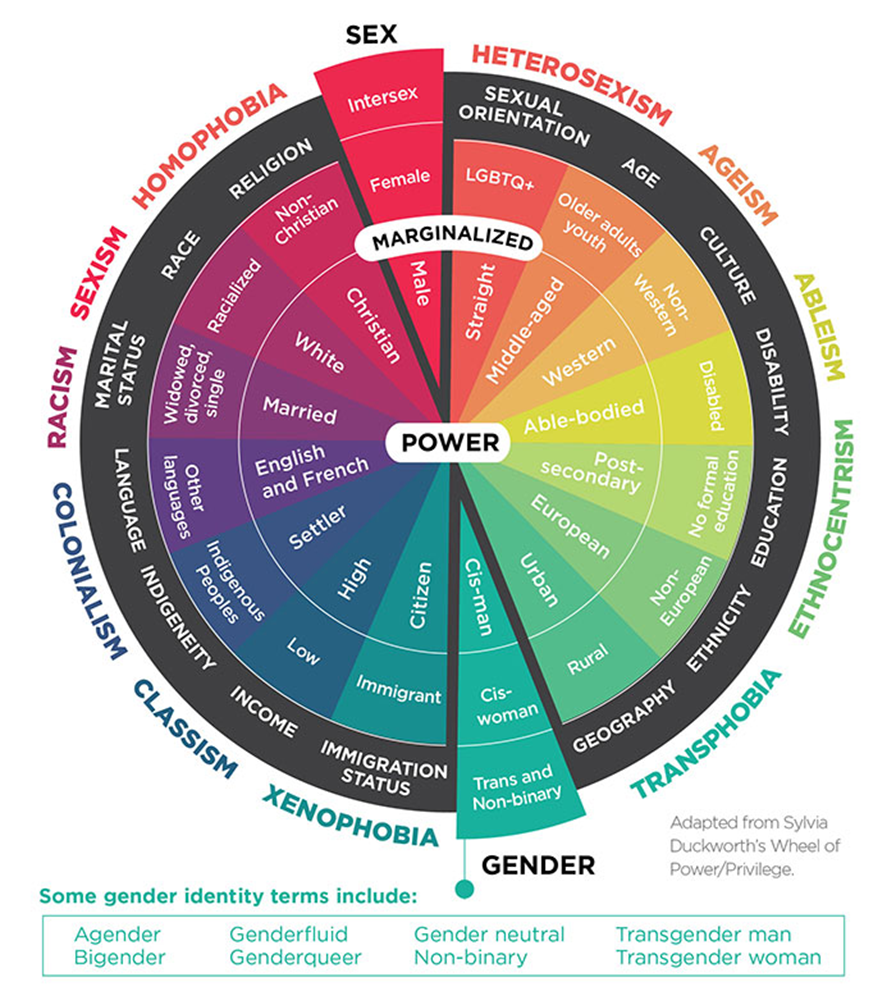
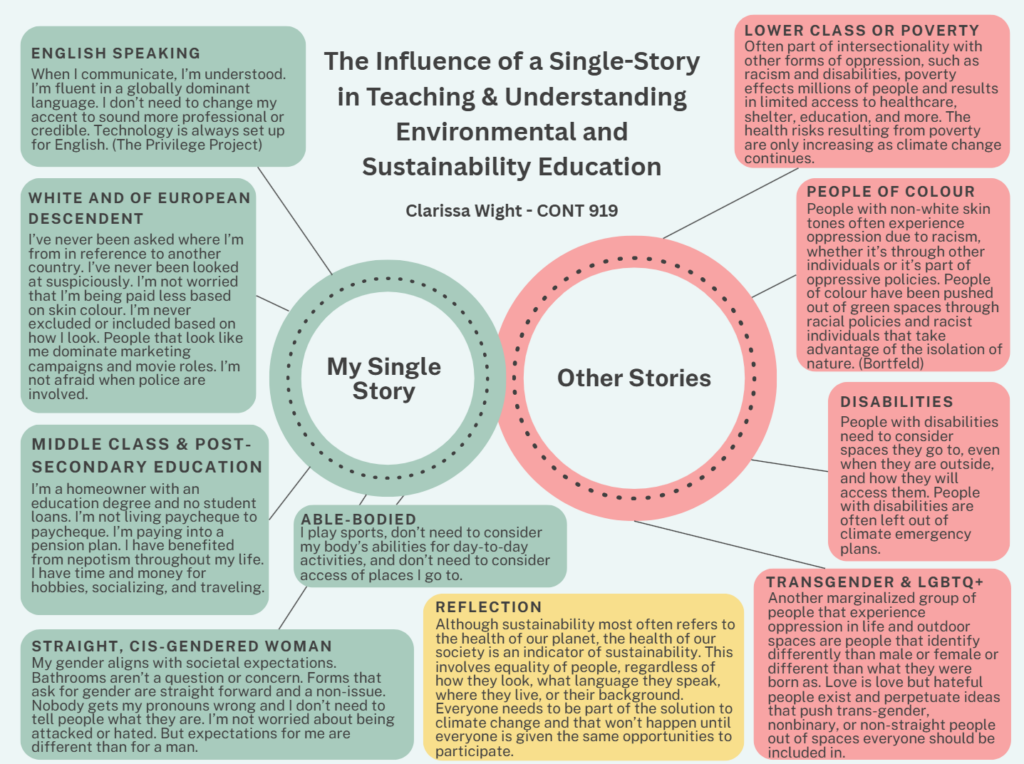
It’s important to recognize that identities will fit into the Flower of Power in a variety of ways and there are many different experiences in life, many involving forms of oppression. These different identities also result in people experiencing climate change differently. The info graph below shows how my story may compare to stories of other people.
Promoting Inclusivity in Outdoor Spaces
Prior to listening to the below podcast, “Environmentalist Drag Queen Pattie Gonia Says The Outdoors is for Everyone,” I didn’t understand that there are groups of people that have been excluded from outdoor spaces. It goes beyond the stereotypical “outdoorsy” look with the trending Patagonia sweater and toque. What I learned is that, throughout history, people have been attacked or murdered for being black, lesbian, gay, or trans while in nature. Protection is in numbers so being isolated while camping or hiking puts people in vulnerable positions. Pattie Gonia started doing drag in the outdoors to make space for people’s differences in nature. People used the idea that transgender is not natural so they shouldn’t be in nature as a reason to push transgender people out of nature. As a straight, white women in a small town, I did not previously understand that forms of oppression are not isolated from nature. It’s important to consider how others experience outdoor spaces and what associations it brings them. Experiences are unique and actively including people is important with these considerations.
Other Forms of Prejudice in the Outdoors
“Fat People Cause Climate Change”
Something I found surprising was that some researchers ever argued that fat people cause climate change. Before reading the article by Constance Russell et al., I had never heard the idea that fat people cause global warming. The arguments are based on bigger people supposedly needing to eat more food, being less willing to walk and travel requiring more fuel, particularly for air travel. I found it very shocking that any researchers would think it makes sense that some people might be eating more than others and that its a “problem” that “fixing” would benefit climate change. As stated in the article, professional athletes eat lots of food but nobody is blaming them for climate change. “Concluding that obesity worsens climate change is as absurd as defending that poverty and malnutrition help prevent this change” (Russell et al., p. 33). Blaming already oppressed people is not the solution to climate change.
The ‘Whiteness’ of Environmental Sciences
Another thing I found surprising is the ‘whiteness’ of both the environment and environmental sciences. In Victoria Bortfeld’s article, she explained how both relate to the history of environmental racism. People of colour have been pushed away from green spaces based on policies such as racialized housing plans and, therefore, don’t have experiences in nature that would lead them to a career in environmentalism. Additionally, when people of colour are experiencing racism, they may not have the mental energy to fight for climate change while continually experiencing oppression. These factors have resulted in environmental sciences being “among the least diverse fields of scientific study” (Bortfeld).
The Intersectionality of Climate Change and Disabilities
The article by Valerie Novack and Daphne Frias challenged my thinking about intersectionality and disability justice. I first learned about intersectionality during CONT 919 and it has taken a bit of thinking to fully grasp the concept. I now understand that it means there is a different experience for people experiencing more than one type of oppression. The compounding effect is different than experiencing the types of oppression separately. Additionally, I hadn’t fully grasped the oppression often resulting from being disabled. Not only are there physical barriers, which become detrimental during an evacuation, but disabled people are often at a financial disadvantage. According to the World Health Organization, 15 percent of the global population live with a disability. Regardless, emergency plans are often made by able-bodied people who don’t think about the needs of people with disabilities. This intersectionality needs to be considered as climate emergencies happen with increasing frequency.
Shifting Values in Gym Class
Something I found inspiring was reading about Hannah and Connie’s personal experiences in gym class and realizing that the values and expectations have shifted. At the start of the “Fatties cause global warming” article, the authors shared their stories about body image and size privilege. Hannah and Connie had similar experiences in gym class that involved judgement from teachers, public weigh-ins, and their value as a person becoming tied to their body weight. (Russell et al.) I remember timed fitness tests and other assessments that were tied to fitness levels. As an educator now, I focus on participation and encouraging students to find passion in learning a new skill. A healthy lifestyle that includes movement won’t result from negative experiences. Realizing this shift in values is happening gives me inspiration and hope that this shift can happen in outdoor education as well. Although this change has happened over decades, I don’t think it’s isolated to my class. As change continues and more inclusive gym classes result in more people having passion for physical activity and being outdoors, hopefully a ripple effect will flow into environmental sciences as well and we’ll see the profession become more diverse.
References
Bauer, Ph.D., Greta. “Quantitative Intersectional Study Design and Primary Data Collection.” Meet the Methods Series, Issue 3 Part 1, Feb. 2021, https://cihr-irsc.gc.ca/e/52352.html.
Bortfeld, Victoria. “This ‘Green’ Space Shouldn’t Be So White.” Columbia Climate School, 21 Aug. 2020, news.climate.columbia.edu/2020/08/21/environmental-sciences-anti-racism/.
Novack, Valerie, and Daphne Frias. “Climate Change, Environmental Activism, and Disability.” Stanford Social Innovation Review, winter 2022, ssir.org/articles/entry/climate_change_environmental_activism_and_disability.
Russell, Constance & Cameron, Erin & Socha, Teresa & McNinch, Hannah. “‘Fatties cause global warming’: Fat pedagogy and environmental education.” Canadian Journal of Environmental Education, 18, January 2013. 27-45.
Published: