
Initiative Goals
#1: Build a school-wide culture of sustainability
A culture of sustainability is a one that can be seen, heard, and felt school wide with values relating to self-awareness, critical thinking, equality, and overall knowledge about climate change that leads students and staff to making personal and collaborative changes with the future in mind.
| A culture of sustainability would … | |
| Look like … | -Visual reminders of core values (Cramer) that include sustainability on hallway bulletin boards and around the school. -A sustainable breakfast and lunch program. -Sustainably managed facilities, including the building and school grounds. -Involving the local community as a setting for project-based learning for sustainability (UNESCO b). -School wide traditions that involve working together for a common sustainability goal. -Student involvement and bottom-up planning because “top-down instructions…may cause a decrease in the willingness to act” (Cantell et al., p. 721). |
| Sound like … | -Teachers asking deep-thinking questions to help students build strategic and critical thinking skills (Cantell et al., p. 118). -Positive and hopeful attitudes and language from teachers because “teachers’ negative attitudes and feelings, such as fear and uncertainty, are linked to students’ attitudes and capacity-building” (Cantell et al., p. 721). |
| Feel like … | -Individuals caring about sustainability and are emotionally invested (Cramer). -Student and staff working collaboratively to meet goals. -A safe space for learning, sharing, and dreaming big (Cramer). -Hands-on learning, activities, and actions. -Taking emotional needs into consideration as learning about climate change “raises strong feelings such as guilt, hopelessness, helplessness, and even anger” (Cantell et al., p. 717). |
| Other | -It would include systems level thinking (Cramer). -Including teaching about sustainability across the curriculum with a holistic approach. -The potential to positively transform the community and the planet (Seydel) |
A culture of sustainability is what drives actions towards sustainability, not the other way around. Otherwise, programs fade out as staff turn over and people lose interest (Cramer).
Currently, although our school is a safe and welcoming environment, these aspects of a culture of sustainability are not seen, heard, or felt in our school.
#2: Improve Sustainability of Facilities and Operations
Between students and staff, our school has more than 600 people spending their day in the building. It’s a very large building, much larger than a single home, that uses lots of energy and produces lots of waste each day. Improving the sustainability of the building and operations will have a positive impact on the environment and have cost saving benefits at the same time.
One of the biggest producers of waste in the school is the food program. Many students eat breakfast and lunch at school. The food is served with disposable plates and cutlery, which fill garbage cans throughout the school. All that waste ends up in the dumpster, which costs money to get emptied, then goes to the landfill. Food waste is not separated from this. The food program also serves meat often, which is not as sustainable as plant-based options. Changes to the food programs and how they operate can both improve the sustainability of the school and serve as a model for students as they learn about nutrition and the impacts of different foods.
There is also a lot of electricity used in the large building. “Lighting accounts for nearly half the electric bill in most schools” (BC Ministry of Education). There are also many computers, laptops, and other electronics used in the school that use electricity.
Although there are many other unsustainable aspects of the school operations and facilities, focusing on these aspects have the potential to be impactful for improving the overall sustainability of the school.
#3: Reduce Carbon Emissions of School Community
Since “transportation contributes a full 45% of total household greenhouse gas emissions in BC” (BC Ministry of Education, p. 27), encouraging the school community, including staff, students, and parents, to reduce their carbon emissions during their daily travel to and from school can add up to major reductions in carbon emissions locally. This is important considering carbon dioxide and methane gas are the cause of climate change and our warming environment. “Burning fossil fuels generates greenhouse gas emissions that act like a blanket wrapped around the Earth, trapping the sun’s heat and raising temperatures” (“What Is Climate Change? | United Nations”). Collectively, our school community can work to reduce climate change daily by making changes to our methods of transportation.
Quality climate education can lead to a reduction in carbon emissions similar to other large-scale mitigation strategies such as rooftop solar or electric vehicles.
Field & Howlett, p. 5
Connections to BC Curriculum
Based on a close analysis of the Grade 7 BC Curriculum, Education for Sustainable Development can easily be weaved into all subjects in grade 7. When considering that Education for Sustainable Development “teaches individuals to make informed decisions and take action, both individually and collectively, to change society and protect the planet [and] equips people of all ages with the knowledge, skills, values, and ability to tackle issues such as climate change, biodiversity loss, overuse of resources, and inequality that impact the well-being of people and the planet” (UNESCO c), it is much broader than just the science of climate change and can be incorporated into the BC curriculum in a variety of ways.
Key Competencies for Sustainability (UNESCO a, p. 10) that connect directly to the BC Core Competencies include strategic thinking, collaboration, critical thinking, self-awareness (personal awareness in BC Curriculum), and problem-solving.
Below are detailed notes about how the curriculum can be fit into Education for Sustainable Development. The details in brackets are examples of how content and ideas can be connected to ESD.
BC Core Competencies
Collaboration:
- includes combining perspectives (Aligns with Two-Eyed Seeing)
Creative Thinking:
- “…involves the generation of ideas and concepts that are novel and innovative” (Sustainable development requires innovation.)
Positive Personal and Cultural Awareness:
- “They contribute to their own well-being and to the well-being of their family, community, and society.”
Social awareness and responsibility:
- “…involves the awareness, understanding, and appreciation of connections among people, including between people and the natural environment.”
- “…focuses on interacting with others and the natural world in respectful and caring ways.”
- “A socially aware and responsible individual contributes positively to their family, community, and environment”
ADST 7
Big Ideas:
- “Design can be responsive to identified needs.” (Could be applied to a sustainability/global need.)
Content:
- Drafting: a module could be centered around sustainable design elements.
- Entrepreneurship and Marketing (A sustainable product/company could be analyzed/developed.)
- Food Studies: “factors that influence food choices, including cost, availability, and family and cultural influences” (Environmental impact of agriculture and supply chains could be explored.)
- Textiles:
- “variety of textile materials” (Environmental impact of different materials)
- “hand construction techniques for producing and/or repairing textile items” (Upcycling or repairing)
Career Education 7
Curricular Competency:
- Recognize their personal preferences, skills, strengths, and abilities and connect them to possible career choices (Could relate to a passion for the environment or climate change.)
- Examine the importance of service learning and the responsibility of individuals to contribute to the community and the world
- Use entrepreneurial and innovative thinking to solve problems (Apply to climate problems.)
Content:
- Project management (Tie to a climate change/environmental project.)
- Problem-solving and decision-making strategies (Climate problems)
- Local and global needs and opportunities: social justice, environmental stewardship, sustainability, effective use of resources, etc. (Include climate refugees)
- Global citizenship (Tied to climate injustices)
- Factors affecting types of jobs in the community (Predicting changes based on switch to sustainable transportation and fuel sources.)
Core French 7
Curricular Competency:
- Explore and share information about Francophone communities across Canada and around the world (Could look at sustainability of other Francophone communities, such as train system in France.)
Content:
- Common, high-frequency vocabulary and sentence structures for communicating meaning (Vocabulary words related to the environment.)
Physical and Health Education 7
Curricular Competency:
- Identify and describe preferred types of physical activity (Discuss physical activity as a transportation method)
- Describe and assess strategies for responding to discrimination, stereotyping, and bullying (Related to inequalities)
Content:
- factors that influence personal eating choices (Supply chain/environmental impact of different foods/food groups)
- basic principles for responding to emergencies (Extreme weather/climate emergencies)
- signs and symptoms of stress, anxiety, and depression (Climate anxiety)
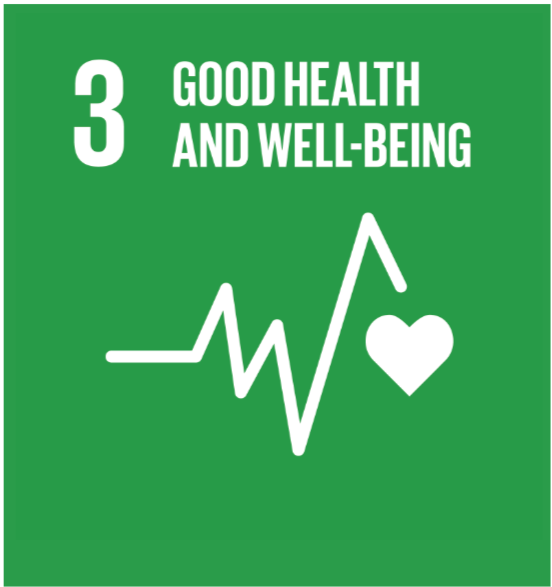
All the connections to health in the curricular competencies and content: Health information can lead to equity as it gives people the knowledge to protect themselves and live a healthy life style. Additionally, health and well-being is one of the United Nation’s Sustainable Development Goals:
Social Studies 7
The Ancient World to the 7th Century
Big Ideas:
- Geographic conditions shaped the emergence of civilizations. (food and water sources)
Content:
- anthropological origins of humans
- the shift of early humans from a nomadic hunter-gatherer way of life to more settled agricultural communities (Gifts of the earth switched to cultivation and commodification)
- human responses to particular geographic challenges and opportunities, including climates, landforms, and natural resources (Although focused on pre-7th century, can be connected to present day)
- features and characteristics of civilizations and factors that lead to their rise and fall
- origins, core beliefs, narratives, practices, and influences of religions, including at least one indigenous to the Americas (Connects to Indigenous Knowledge of the environment)
- social, political, legal, governmental, and economic systems and structures, including at least one indigenous to the Americas (Economic systems relate to commodification of Earth’s resources.)
Arts Education 7
Curricular Competency:
- Intentionally select and apply materials, movements, technologies, environments, tools, and techniques by combining and arranging artistic elements, processes, and principles in art making (Discuss sustainably sourced materials)
- Demonstrate an understanding and appreciation of personal, social, cultural, historical, and environmental contexts in relation to the arts
- Research, describe, interpret and evaluate how artists, including dancers, actors, musicians, and visual artists, use processes, materials, movements, technologies, tools, techniques, and environments in the arts
- Take creative risks to express feelings, ideas, and experiences (Apply to ideas/feelings about climate change/environmental issues.)
- Symbolism and metaphor to explore ideas and perspective
Example of Art and Climate Change:
English Language Arts 7
Big Ideas:
- Exploring stories and other texts helps us understand ourselves and make connections to others and to the world. (Include stories related to sustainability/climate change/equality)
- Exploring and sharing multiple perspectives extends our thinking.
- Questioning what we hear, read, and view contributes to our ability to be educated and engaged citizens. (Thinking critically is a skill that can be extended to important topics and this idea connects to global citizenship.)
Curricular Competency:
- Recognize the validity of First Peoples oral tradition for a range of purposes (Connects to Two-Eyed Seeing)
*Use sustainable development related content language skills
Mathematics 7
Big Ideas:
- Data from circle graphs can be used to illustrate proportion and to compare and interpret. (Look at circle graphs related to sustainable development.)
Curricular Competency:
- Engage in problem-solving experiences that are connected to place, story, cultural practices, and perspectives relevant to local First Peoples communities, the local community, and other cultures
- Connect mathematical concepts to each other and to other areas and personal interests (Connect math to the environment/climate change)
- Incorporate First Peoples worldviews and perspectives to make connections to mathematical concepts (Connection to Two-Eyed Seeing)
Science 7
Big Ideas:
- Evolution by natural selection provides an explanation for the diversity and survival of living things. (Connects to climate change and biodiversity loss)
- The electromagnetic force produces both electricity and magnetism. (Includes sustainable generation of electricity)
- Earth and its climate have changed over geological time.
Curricular Competency:
- All the “Processes” could be applied to sustainability and environmental topics.
- Experience and interpret the local environment
Content:
- organisms have evolved over time
- survival needs
- natural selection
- electricity
- generated in different ways with different environmental impacts
- the fossil record provides evidence for changes in biodiversity over geological time
- First Peoples knowledge of changes in biodiversity over time
- evidence of climate change over geological time and the recent impacts of humans:
- physical records
- local First Peoples knowledge of climate change
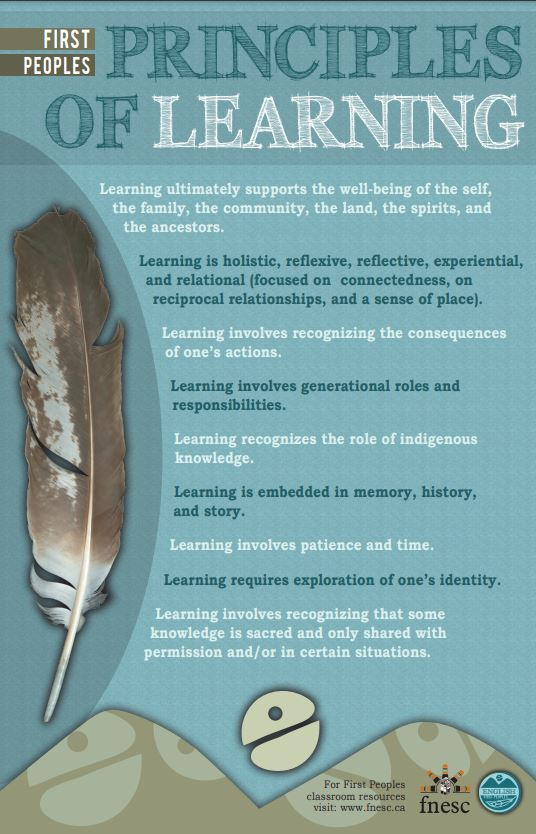
Connections to the First Peoples of Learning
The First Peoples Principles of Learning, developed by FNESC, are a set of principles focused on teaching pedagogy that align with education for sustainable development. As stated by FNESC, “they represent an attempt to identify common elements in the varied teaching and learning approaches that prevail within particular First Nations societies. It must be recognized that they do not capture the full reality of the approach used in any single First Peoples’ society.”
Since colonialism and the industrial revolution are the cause of climate change, the Indigenous perspective has been historically more sustainable than the western perspective. Since time immemorial, they lived off the land in a sustainable way until colonizers disrupted their way of life, resulting in negative effects for the environment and atmosphere. With their close relationship to the land, “Indigenous peoples are on the frontlines of climate change, because they are disproportionately affected by it, and yet contribute relatively little to the problem” (Climate Atlas of Canada). With this in mind, we need to work closely with Indigenous peoples to both support them and learn from them. According to Leroy Little Bear, “we must move beyond the either/or mentality of western thought: ‘We’re not talking about either Western science or native science. What we’re talking about is a marriage of the two, because that’ll bring about enrichment. That’s what we refer to as a holistic approach'” (Climate Atlas of Canada).
Two-Eyed Seeing
Two-Eyed Seeing is a guiding principle that acknowledges the multiple perspectives available resulting from colonization. It means using the strengths of different perspectives and ways of thinking and using them in harmony for the greater good. It involves working together instead of considering one way of thinking as superior to others. Respecting each other and teaching each other to find solutions together is part of Two-Eyed Seeing. As described by Albert Bartlett, Two-Eyed Seeing “refers to learning to see from one eye with the strengths of Indigenous knowledges and ways of knowing, and from the other eye with the strengths of Western knowledges and ways of knowing, and to using both these eyes together, for the benefit of all” (Barlett, p. 335).
I believe this concept can influence my teaching practices by removing the idea that one method of studies is superior to the other. So often we, as a colonial society, focus on the scientific method and western ways of thinking without considering that it’s strengths can be learned and taught in tandem with Indigenous knowledge. Weaving the two together can teach cultural awareness and respect while also building respect for the land and the living things around us.
7 Generations
The 7 Generations teaching is important for sustainability because it teaches the need to consider our impact on ourselves and those that will come after us. It’s the idea that everyone has parents, grandparents, and great-grandparents. There are also children, grandchildren, and great-grandchildren. As you move through the generations during life, the impact on those generations all need to be considered because our actions can be far reaching.
References
Academic Algonquin. “Seven Generations.” YouTube, 18 May 2017, https://www.youtube.com/watch?v=wHg3enCCyCM
Bartlett, Cheryl, et al. “Two-Eyed Seeing and Other Lessons Learned within a Co-Learning Journey of Bringing Together Indigenous and Mainstream Knowledges and Ways of Knowing.” Journal of Environmental Studies and Sciences [New York], vol. 2, no. 4, November 2012, pp. 331–40, https://doi.org/10.1007/s13412-012-0086-8.
BC Ministry of Education. Sustainable Schools Best Practices Guide. https://www2.gov.bc.ca/assets/gov/education/kindergarten-to-grade-12/teach/teaching-tools/environmental-learning/sustbestpractices.pdf.
Cantell, Hannele, et al. “Bicycle Model on Climate Change Education: Presenting and Evaluating a Model.” Environmental Education Research, vol. 25, no. 5, May 2019, pp. 717–31, https://doi.org/10.1080/13504622.2019.1570487.
Climate Atlas of Canada. “Indigenous Knowledges and Climate Change.” n.d., https://climateatlas.ca/indigenous-knowledges-and-climate-change
“Curriculum | Building Student Success – B.C. Curriculum.” Government of British Columbia, n.d., curriculum.gov.bc.ca/curriculum.
Cramer, Jenna. “Fostering a Culture of Sustainability in Schools: Getting to the ‘Why.’” Green Schools National Network, 1 Mar. 2016, greenschoolsnationalnetwork.org/fosteringacultureofsustainability/.
Field, E., Howlett, S. (2023). Climate Leadership within Canadian School Boards: 2023 Review. https://climatechangelearningcanada.org/2023-review/
First Nations Education Steering Committee. “First Peoples Principles of Learning.” https://www.fnesc.ca/first-peoples-principles-of-learning/.
Seydel, Jennifer. “Where We Learn Matters: A Culture of Sustainability is a Hallmark of a Green, Healthy, Sustainable School.” Green School National Network, Nov. 2017. https://myemail.constantcontact.com/Where-We-Learn-Matters–A-Culture-of-Sustainability-is-a-Hallmark-of-a-Green–Healthy–Sustainable-School.html?soid=1114094375959&aid=oj4-SkeMkzU.
UNESCO a. Education for Sustainable Development Goals: learning objectives. France, United Nations Educational, Scientific and Cultural Organization, 2017, https://unesdoc.unesco.org/ark:/48223/pf0000247444.locale=en.
UNESCO b. “Transforming Learning Environments” in Education for Sustainable Development: A roadmap. France, 2020. p. 28. https://unesdoc.unesco.org/ark:/48223/pf0000374802.locale=en.
UNESCO c. “What You Need to Know about Education for Sustainable Development.” UNESCO, 8 Apr. 2026, www.unesco.org/en/sustainable-development/education/need-know.
“What Is Climate Change? | United Nations.” United Nations, www.un.org/en/climatechange/what-is-climate-change. Accessed 3 July 2026.
Published: