Make Math Moments Virtual Summit
Fractions are a gateway to higher mathematics.
Related book: Rethinking Fractions: 8 Core Concepts to Support Learning and Assessment
www.fractionslearningpathways.ca for more learning resources.
Use Powerful Representations
Key representations include a set model (parts of a whole), linear models, volume models, rectangular area models, and arrays.
Circles aren’t the best option. They are hard to equally divide larger numbers. Usually, pizza pieces aren’t cut equally anyways.
Number lines are usually familiar to students for whole numbers.
Greater than and less than using rectangular area models to introduce new representation.
Number Line Activity
4 number lines: One labeled o and 1; next one labeled 1/2 and 2/2. The length of the line represented the whole. Label the next line into 1/4. Label the last one into 8ths.
Note: Halves are often understood by kindergartens, sometimes even a quarter.
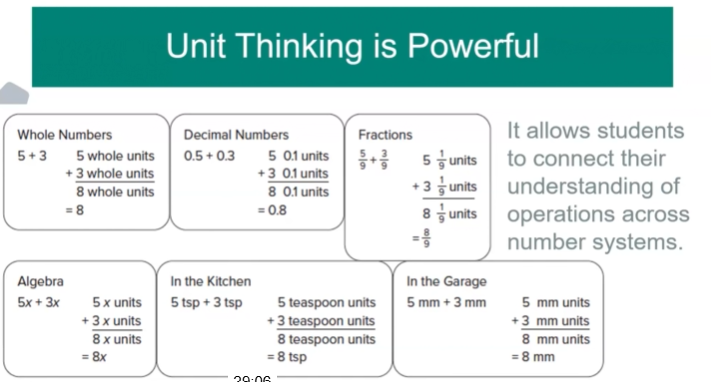
Unit fractions are powerful (1/#)
Paper folding is a powerful representation.
Provide lots of opportunities to count by unit fractions
Counting by unit fractions: “2 one-sixths” = 2/6. Do this standing in a circle. Students clap when they arrive at a whole number and say 6 one-sixths and the whole number equivalent. Count past one whole.
Landing Game: In groups counting by unit fractions, think about a unit fraction so you can count around the group once and end between the whole numbers of 1 and 2. Example: a group of 3 people counts by halves.
Or, use the divided strips of coloured paper in a sheet protector.
Counting by unit fractions helps:
- one-to-one correspondence (matching each object in one set to exactly one object in another set)
- ordinality (understanding numbers as positions in a sequence)
- cardinality (knowing the last number counted represents the total quantity)
- magnitude (recognizing relative size or value of numbers)
- number relationships (understanding how numbers connect through operations and patterns).
Engage with fractions greater than 1 whole
Activity to do with students:
Draw a number line from 0 to 4. Determine where 1/2 goes on the line. Then, determine where the 2 belongs.
Correct place is 1/2 goes between o and 1, not half the line between 0 and 4. 1/2 is being treated as a number.
3/3 is 1 whole. 6/3 is 2 wholes. 5/3 is 1 & 2/3.
Counting quantities is building the skill of adding fractions.
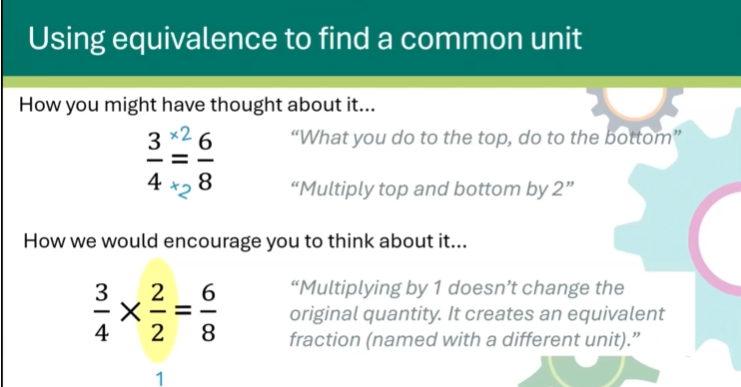
Provide opportunities to compose and decompose fractions
Leave a Reply
You must be logged in to post a comment.